- 10 June 24
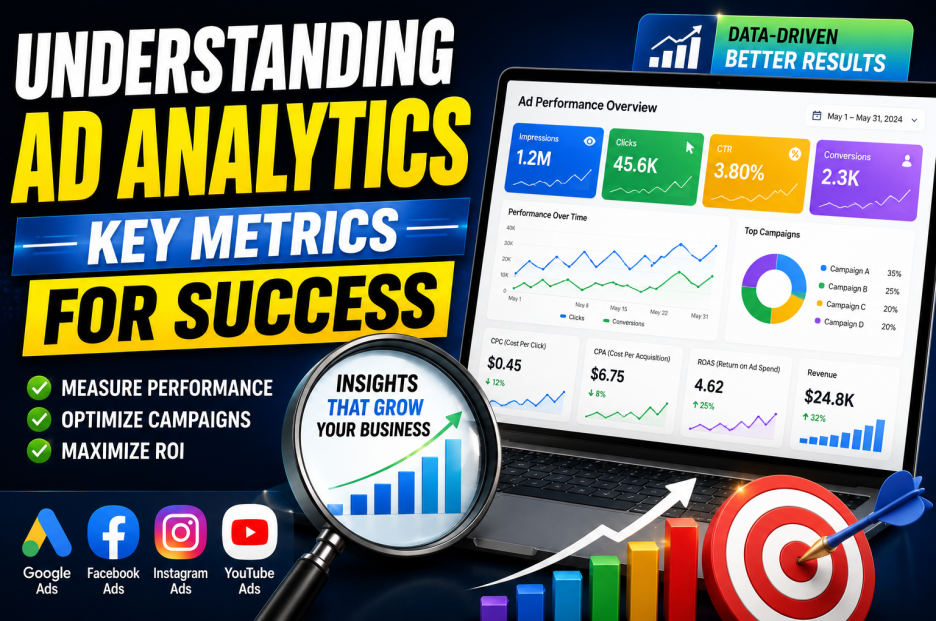
Understanding Ad Analytics: Key Metrics for Advertising Success
Understanding Ad Analytics: Key Metrics for Advertising Success
Introduction
In today's digital marketing landscape, running advertisements is only half the battle. The real challenge lies in understanding how those advertisements perform and using data to improve results. This is where ad analytics becomes essential.
Ad analytics provides businesses, advertisers, publishers, and marketers with valuable insights into campaign performance. It helps identify what's working, what needs improvement, and where marketing budgets should be allocated for maximum return.
Without proper analysis, advertising campaigns can waste money, miss opportunities, and fail to reach their full potential. By understanding key advertising metrics, businesses can make smarter decisions, optimize campaigns, increase conversions, and maximize return on investment (ROI).
This comprehensive guide explores ad analytics, the most important performance metrics, and how businesses can use data-driven insights to achieve advertising success.
What Is Ad Analytics?
Ad analytics refers to the process of collecting, measuring, analyzing, and interpreting data generated by advertising campaigns.
The primary goal of ad analytics is to evaluate campaign effectiveness and identify opportunities for improvement.
Advertising platforms such as Google Ads, Facebook Ads, Instagram Ads, YouTube Ads, LinkedIn Ads, and display advertising networks provide extensive data that helps marketers understand audience behavior and campaign performance.
Ad analytics answers critical questions such as:
How many people viewed the advertisement?
How many users clicked on the ad?
Which audience segments performed best?
How much did each conversion cost?
Was the campaign profitable?
What improvements can be made?
By answering these questions, businesses can continuously improve their advertising strategies.
Why Ad Analytics Matters
Many advertisers focus solely on impressions or clicks. However, successful advertising requires a deeper understanding of performance data.
Better Decision Making
Ad analytics provides accurate data rather than assumptions.
Businesses can make informed decisions based on real performance metrics.
Improved Return on Investment
Tracking campaign performance helps advertisers allocate budgets toward high-performing ads while eliminating underperforming campaigns.
Enhanced Audience Understanding
Analytics reveals valuable information about customer behavior, interests, demographics, and purchasing patterns.
Continuous Optimization
Data-driven insights allow marketers to test, refine, and improve campaigns over time.
Competitive Advantage
Organizations that leverage analytics effectively often outperform competitors by making smarter advertising decisions.
Key Advertising Metrics Every Marketer Should Understand
1. Impressions
Impressions represent the number of times an advertisement is displayed to users.
For example:
If an ad appears on a webpage 10,000 times, it receives 10,000 impressions.
Impressions help measure:
Brand visibility
Campaign reach
Awareness potential
However, impressions alone do not indicate engagement or conversions.
2. Reach
Reach measures the number of unique users who have seen an advertisement.
For example:
Impressions: 50,000
Reach: 20,000
This means some users saw the ad multiple times.
Reach is particularly important for brand awareness campaigns.
3. Click-Through Rate (CTR)
CTR measures the percentage of users who click on an advertisement after seeing it.
Formula:
CTR = (Clicks ÷ Impressions) × 100
CTR=\frac{Clicks}{Impressions}\times100
A higher CTR generally indicates that:
The ad is relevant.
The creative is engaging.
The targeting is effective.
Low CTR often signals that adjustments are needed.
4. Cost Per Click (CPC)
CPC measures how much an advertiser pays for each click.
Formula:
CPC = Total Ad Spend ÷ Total Clicks
CPC=\frac{Total\ Ad\ Spend}{Total\ Clicks}
Lower CPC often indicates greater efficiency, although quality traffic remains more important than cheap clicks.
5. Conversion Rate
Conversion rate measures the percentage of users who complete a desired action after clicking an ad.
Actions may include:
Purchases
Sign-ups
Downloads
Form submissions
Newsletter subscriptions
Formula:
Conversion Rate = (Conversions ÷ Clicks) × 100
Conversion\ Rate=\frac{Conversions}{Clicks}\times100
A strong conversion rate suggests effective targeting and landing page optimization.
6. Cost Per Acquisition (CPA)
CPA measures the average cost required to acquire a customer or conversion.
Formula:
CPA = Total Ad Spend ÷ Total Conversions
CPA=\frac{Total\ Ad\ Spend}{Total\ Conversions}
CPA helps businesses determine whether campaigns are financially sustainable.
Lower CPA generally indicates greater profitability.
7. Return on Ad Spend (ROAS)
ROAS measures revenue generated for every dollar spent on advertising.
Formula:
ROAS = Revenue Generated ÷ Advertising Cost
ROAS=\frac{Revenue\ Generated}{Advertising\ Cost}
For example:
Revenue = $10,000
Ad Spend = $2,000
ROAS = 5
This means every $1 spent generated $5 in revenue.
ROAS is one of the most important advertising metrics.
8. Bounce Rate
Bounce rate measures the percentage of visitors who leave a website without interacting further.
A high bounce rate may indicate:
Poor landing page design
Slow website speed
Irrelevant traffic
Weak user experience
Reducing bounce rates can significantly improve campaign performance.
9. Engagement Rate
Engagement metrics include:
Likes
Shares
Comments
Video views
Reactions
Engagement rates help advertisers understand how audiences interact with content.
High engagement often leads to stronger brand awareness and audience trust.
10. Customer Lifetime Value (CLV)
CLV estimates the total revenue a customer generates throughout their relationship with a business.
Understanding CLV helps marketers determine how much they can afford to spend on customer acquisition.
Businesses with high CLV can justify larger advertising budgets.
How Ad Analytics Improves Campaign Performance
Audience Optimization
Analytics helps identify high-performing audience segments.
Advertisers can focus budgets on users who are most likely to convert.
Creative Optimization
Performance data reveals which:
Headlines perform best
Images generate engagement
Videos drive conversions
Calls-to-action attract clicks
This information helps improve future campaigns.
Budget Allocation
Rather than distributing budgets evenly, advertisers can invest more in campaigns producing the strongest results.
A/B Testing
Testing different versions of advertisements allows marketers to compare performance and identify winning strategies.
Common testing elements include:
Headlines
Images
Ad copy
Landing pages
Audience segments
Common Ad Analytics Mistakes
Focusing Only on Clicks
Clicks are important but do not guarantee conversions.
Always evaluate deeper performance metrics.
Ignoring Conversion Tracking
Without conversion tracking, advertisers cannot accurately measure success.
Overlooking Audience Data
Understanding customer behavior is critical for campaign optimization.
Making Decisions Too Quickly
Advertising campaigns require sufficient data before meaningful conclusions can be drawn.
Patience often leads to better optimization decisions.
The Future of Ad Analytics
Artificial Intelligence (AI) and machine learning are transforming advertising analytics.
Future developments include:
Predictive performance forecasting
Automated optimization
Real-time audience segmentation
Advanced attribution modeling
Personalized advertising experiences
These innovations will make advertising more efficient and data-driven than ever before.
Conclusion
Understanding ad analytics is essential for modern marketing success. Data provides the foundation for smarter decisions, improved targeting, better customer experiences, and stronger advertising performance.
By monitoring key metrics such as impressions, reach, CTR, CPC, conversion rate, CPA, ROAS, and customer lifetime value, businesses can optimize campaigns and maximize profitability.
Advertising success is no longer based on guesswork. It is built on accurate data, continuous testing, and strategic optimization.
Organizations that embrace ad analytics gain valuable insights that help them outperform competitors, increase conversions, and achieve long-term growth in an increasingly competitive digital marketplace.